Introduction to FSSAI Registration in Mumbai
FSSAI Registration in Mumbai is mandatory for all food business operators (FBOs), regardless of their size or nature of operations. As one of India’s largest metropolitan cities and the commercial hub of Maharashtra, Mumbai has a massive and rapidly growing food industry—including restaurants, tiffin services, food startups, cloud kitchens, packaged food units, bakeries, and large manufacturing plants. To operate legally and maintain consumer trust, every food business in Mumbai must comply with the rules and guidelines of the Food Safety and Standards Authority of India (FSSAI).
This comprehensive guide covers everything you need to know about FSSAI Registration in Mumbai, including license types, required documents, fees, the step-by-step online application process, renewal, compliance, penalties, and for businesses looking to establish credibility in the competitive Mumbai food market.
Why FSSAI Registration Is Essential for Food Businesses in Mumbai
Mumbai’s food sector is highly regulated due to the large population, variety of cuisines, dense retail markets, and fast-growing food e-commerce industry. FSSAI registration ensures food safety, quality, and hygiene.
Key benefits include:
- Legal authorization to operate any food business
- Boosts customer trust and brand credibility
- Helps with online listing on platforms like Swiggy, Zomato, Amazon, BigBasket
- Ensures compliance with national food safety standards
- Enables expansion to multiple outlets or large retail partnerships
- Protects the business from penalties or closure
- Mandatory for packaged and labeled food items
In a city like Mumbai, consumer awareness around food safety is high. Businesses with a valid FSSAI License are more likely to gain customer confidence and long-term growth.
Call us at 70090-29984 or 96460-01340 for any query
Who Needs an FSSAI License in Mumbai?
Any person or organization involved in activities related to food must obtain an FSSAI Registration or License.
This includes:
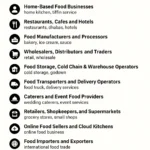
- Restaurants, cafes, bars, hotels, and food courts
- Cloud kitchens, home kitchens, and tiffin services
- Bakeries, sweet shops, ice-cream parlors
- Meat shops, seafood traders, and frozen food sellers
- Grocery stores, supermarkets, retail and wholesale traders
- Food manufacturers, processors, repackers
- Catering services and event food suppliers
- Dairy and milk product units
- Transporters, cold storage units, and warehouses
- Importers or exporters of food products
As per FSSAI rules, no food business in Mumbai can legally operate without proper registration or licensing.
Types of FSSAI Registration in Mumbai
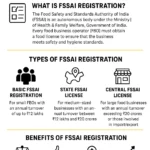
FSSAI offers three main categories of registration and licenses depending on business turnover, scale, and type of activity.
Basic FSSAI Registration (For Small Businesses)
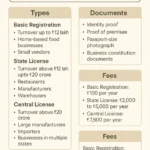
This type of registration is applicable for businesses with an annual turnover of up to ₹12 lakh.
Examples:
- Small home kitchens
- Local tiffin services
- Small bakeries
- Petty retailers and hawkers
- Small-scale handmade food sellers
Basic FSSAI Registration is the simplest category with minimal documentation.
State FSSAI License (For Medium-Sized Businesses)
This license applies to businesses with an annual turnover between ₹12 lakh and ₹20 crore.
This includes:
- Mid-range restaurants, cafes, and food joints
- Medium-scale manufacturers
- Distribution and wholesale units
- Medium-sized dairy and bakery businesses
- Caterers serving large events
Most mid-level companies in Mumbai fall under this category due to the city’s high commercial activity.
Central FSSAI License (For Large & Interstate Businesses)
Businesses must apply for a Central FSSAI License if their turnover exceeds ₹20 crore, or if they operate across multiple states.
Applicable to:
- Large food manufacturing plants
- Importers and exporters
- Major food franchises
- Food e-commerce operators
- Large dairy units and processing units
- Companies distributing food to multiple states
This license category has the highest level of compliance and documentation requirements.
Documents Required for FSSAI Registration in Mumbai
Accurate and complete documentation is essential to avoid rejection or delays.
Documents Required for Basic FSSAI Registration
- Passport-size photo of the applicant
- Aadhaar Card / PAN Card
- Business premises proof (rent agreement, utility bill, etc.)
- Details of food items handled
- Business name and address details
- Declaration form
Documents Required for State & Central FSSAI License
- Completed Form B (signed)
- Proof of premises ownership or rental
- Layout plan of the premises
- List of machinery and equipment
- Food Safety Management System (FSMS) plan
- Water testing report (for manufacturing units)
- Company registration documents (Partnership Deed / LLP / Pvt. Ltd.)
- List of directors/partners with identity proofs
- Authorized signatory letter
- Turnover proof (GST return / Balance sheet)
- NOC from Municipality / BMC (if required)
Mumbai businesses should also ensure that all documents are updated and with correct addresses, as BMC (Brihanmumbai Municipal Corporation) authorities conduct strict verification.
Step-by-Step Process for FSSAI Registration in Mumbai
The FSSAI registration process is conducted entirely online via the FoSCoS portal.
Step 1: Identify the Correct License Category
Your license type depends on:
- Annual turnover
- Nature of food activities
- Number of outlets
- Production capacity (for manufacturers)
Step 2: Create an Account on FoSCoS
Visit the Food Safety Compliance System (FoSCoS) website and register with your mobile number and email ID.
Step 3: Fill Out the Application Form
- Use Form A for Basic Registration
- Use Form B for State & Central License
Provide all business details, food categories, and upload required documents.
Step 4: Pay Government Fees Online
Fees vary based on:
- License validity (1 to 5 years)
- License category
In Mumbai, many businesses opt for 5-year validity to avoid frequent renewals.
Step 5: Inspection of Premises (If Applicable)
State and Central license applicants may receive an inspection from a Food Safety Officer (FSO).
They verify:
- Hygiene standards
- Safety measures
- Production facility layout
- Storage and waste management systems
Step 6: Issuance of FSSAI Certificate
Upon approval, businesses receive a 14-digit FSSAI license number.
This must be:
- Displayed at the place of business
- Printed on packaged food labels
- Shown on invoices and marketing materials (if required)
FSSAI License Fees in Mumbai
The fee structure varies for each category:
- Basic Registration: Lowest fee
- State License: Moderate fee
- Central License: Higher fee due to large operations
Exact fee values depend on business type, scale, and validity duration.
Validity and Renewal of FSSAI License in Mumbai
- Validity ranges from 1 to 5 years
- Renewal must be applied 30 days before expiry
- Late renewal attracts penalties
- Operating with an expired license can lead to prosecution
To avoid disruptions, Mumbai businesses should maintain automated reminders for renewal dates.
Modification, Surrender, and Duplicate FSSAI License
When to Modify Your FSSAI License
Modifications are needed when:
- Business address changes
- Product category expands
- Machinery or processing capacity changes
- Change in business ownership or entity type
Duplicate License
A duplicate license can be issued if the original certificate is lost or damaged.
Surrender License
Required when the business shuts down permanently or stops its food-related activities.
FSSAI Compliance Requirements for Mumbai Businesses
Mumbai food businesses must follow strict compliance norms due to high customer footfall and BMC regulations.
Compliance includes:
- Displaying the FSSAI license at the premises
- Maintaining hygiene standards in kitchen/storage
- Regular pest control
- Using safe, high-quality raw materials
- Proper waste disposal (important for BMC compliance)
- Following labeling rules
- Keeping records of suppliers and production
- Staff training in food safety
- Maintaining temperature logs for frozen/chilled foods
Good compliance improves inspection ratings and prevents penalties.
Penalties for Non-Compliance in Mumbai
FSSAI and BMC take strict action against violations.
Penalties may include:
- Fines up to ₹5 lakh
- License suspension or cancellation
- Sealing of premises
- Product recall
- Criminal charges in severe cases
Regular audits and adherence to standards help avoid these issues.
Benefits of FSSAI Registration for Mumbai’s Food Industry
Mumbai’s food market is extremely competitive. An FSSAI license helps food businesses:
- Build customer trust
- Secure partnerships with malls and supermarkets
- Get listed on food delivery apps
- Expand to multiple outlets
- Improve product reputation
- Grow into national or export markets
Frequently Asked Questions (FAQs)
1. Is FSSAI License mandatory for restaurants in Mumbai?
Yes. Every restaurant must have at least a State FSSAI License.
2. Can I apply online for FSSAI Registration in Mumbai?
Yes. The process is fully online via the FoSCoS portal.
3. How long does the licensing process take?
Basic registration takes a few days, while State and Central licenses may take several weeks depending on inspection.
4. Do tiffin services in Mumbai need FSSAI Registration?
Yes. Even home kitchens and tiffin providers require Basic Registration.
5. What happens if a business operates without an FSSAI license?
The business may face penalties, closure, and legal action.
Conclusion
FSSAI Registration in Mumbai is a crucial requirement for every food business operator. Whether you operate from home or run a large factory, obtaining the right FSSAI license ensures compliance, safety, and long-term business growth. By following the correct application process, preparing complete documents, and maintaining hygiene standards, businesses can operate legally and gain customer trust in Mumbai’s competitive food industry.